
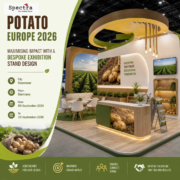
Potato Europe 2026: Maximizing Impact With a Bespoke Exhibition Stand Design
Whenever we get to know a trade show is going to take place, the first thing that comes to our mind is rows of shell-scheme booths under fluorescent lighting. However, Potato Europe isn’t that kind of show at all. It’s an open-air exhibition run with genuine field-day character, and that single fact changes almost every decision that goes into building a stand for it.
A Different Kind of Show, Held at a New Venue
Potato Europe 2026 runs on 9 and 10 September at the Rittergut Gestorf 1 estate near Hanover – the first time the show’s taken place at this particular venue. It’s part of a four-country rotation covering Germany, Belgium, France, and the Netherlands, and this year it runs alongside the newly launched SugarBeet Expo on the same grounds, which pulls in a broader mix of agricultural professionals than a potato-only show would draw on its own.
The whole event centres on live machinery demonstrations, working trial fields, and direct conversation between growers, processors, and equipment suppliers. Exhibitors here aren’t standing behind a counter handing out brochures they’re running equipment, showing it working in actual field conditions, and talking through technical detail with people who genuinely understand the machinery. That context matters a lot for anyone planning an exhibition stand in Germany for this specific event, since a standard indoor-hall approach just doesn’t map onto an open field setting.
What Changes When the Show Is Outdoors
A stand built for a convention centre and a stand built for an open field aren’t solving the same problem. A few things become non-negotiable once you’re working outdoors:
- Structures that actually handle weather, since September near Hanover can swing between sun, wind, and rain within the same afternoon
- Ground conditions, given this is a working agricultural estate rather than a flat, paved exhibition floor
- Visibility across open sightlines, where a stand competes for attention across much more distance than a tightly packed indoor aisle
- Room built specifically for live demonstrations, since that’s where most of the actual exhibitor activity happens at this show
None of these on their own is complicated. Coordinating all of them together, inside a fixed footprint on unfamiliar terrain, is where the real planning work sits.
Why a Bespoke Approach Actually Matters Here
A generic booth template built for a standard trade fair doesn’t hold up well against these conditions, which is exactly the case for genuinely bespoke exhibition stand design rather than adapting something built for a different kind of event. Growers and agricultural technology buyers respond to practical clarity – clear signage, functional demonstration space, equipment that’s easy to see and easy to walk up to – rather than a polished, corporate-style display that would feel out of place next to a working field trial.
Spectra Creatives builds stands with this distinction in mind, treating an outdoor agricultural exhibition as a genuinely different design problem rather than shrinking down a convention-hall concept to fit a tent.
The Value of Working With Local Builders
Anyone planning to work with stand builders Germany trusts for this kind of show needs a team that actually understands outdoor exhibition builds – weatherproofing, ground assessment, and power distribution across a spread-out site, none of which come up the same way at an indoor venue. A team without that experience risks a structure that would perform fine at a typical convention centre but underperforms the moment wind picks up or the ground turns soft after rain.
Local execution also matters logistically. Coordinating installation around a working agricultural estate, rather than a standard loading dock and fixed move-in schedule, takes familiarity with how this specific type of venue actually operates on the ground.
Planning Around a New Venue
Because Rittergut Gestorf 1 is hosting the show for the first time, exhibitors are working with less established groundwork than they’d have at a returning location. Confirming ground access, power requirements, and structural specifications early matters more this year than it would at a familiar, previously used site. Waiting until the week before to sort these details out leaves very little room to adjust if something about the site doesn’t match expectations.
Bringing It All Together
A stand at Potato Europe succeeds by matching the actual environment it’s built for – weather-resistant, properly sited, and designed around live demonstration rather than static display. That’s a genuinely different brief from most trade shows, and treating it as one from the start avoids the scramble that comes from realising too late that an indoor concept doesn’t translate outdoors.
Spectra Creatives works with exhibitors well ahead of each show date, adapting design and build methods to the actual conditions a venue presents, from a convention hall floor to open field terrain near Hanover. So, the exhibitors arrive at Potato Europe 2026 with a stand genuinely built for the ground it’s standing on, not just a good-looking booth borrowed from a different kind of show.

 Germany: