
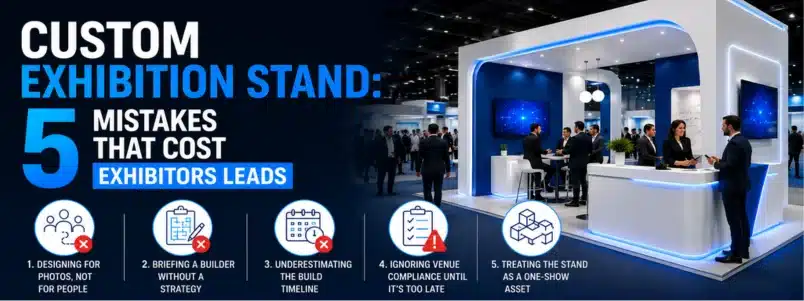
Custom Exhibition Stand: 5 Mistakes That Cost Exhibitors Leads
Exhibiting at a trade show is a significant investment – floor space, travel, staffing, logistics, and the stand itself. Most exhibitors spend months planning the commercial side of the show and far less time thinking critically about the booth that’s supposed to make it all work. The result is a custom exhibition stand that looks fine on the outside but quietly bleeds leads throughout the event.
These are the five mistakes that come up repeatedly, and what they actually cost.
1. Designing for Photos, Not for People
A stand that photographs beautifully but doesn’t work in practice is one of the most common and expensive mistakes in custom exhibition stand design. Dramatic lighting rigs, bold geometric structures, and striking visual concepts are all legitimate design tools, but when exhibitors prioritise dramatic visuals over visitor flow, conversation space, and practical staff positioning, the booth ends up serving the Instagram post rather than the sales conversation.
Before the team approves any concept, the question worth asking is: where does a visitor naturally go when they walk into this space? and what do they do when they get there? If that question doesn’t have a clear answer in the design, it’s a problem that won’t get solved on the show floor.
2. Briefing a Builder Without a Strategy
A custom exhibition stand builder needs more than dimensions and a logo file. The brief has to include what the stand is supposed to achieve – which products are being featured, what kind of conversations the sales team needs to have, how many visitors the space needs to handle at peak times, and what a successful interaction looks like from start to finish.
Builders who receive a vague brief build a vague stand. The result is often a well-fabricated structure that doesn’t actually support the commercial objectives it was supposed to serve. The design process should start with strategy, not with aesthetics.
3. Underestimating the Build Timeline
Custom build exhibition stands take time – design, approval rounds, fabrication, quality checking, logistics, and on-site installation all need to happen in sequence. Compressing that timeline doesn’t make the stand cheaper or faster to produce; it just shifts the risk from the planning stage to the build stage, where problems are harder and more expensive to fix.
The most common version of this mistake is finalising the brief too late. A brief confirmed six weeks before a major show gives a very different outcome to one confirmed sixteen weeks out. The rushed timeline forces the production team to create a stand quickly, and the poor results from the show floor often trace back to the planning failure that caused them.
4. Ignoring Venue Compliance Until It’s Too Late
Every major exhibition venue has its own set of regulations – height restrictions, fire safety certifications, material standards, electrical requirements, rigging approvals, and build window constraints. These aren’t optional or negotiable, and venue authorities modify or remove a non-compliant stand before the show opens.
This happens more often than exhibitors expect, and almost always because compliance was treated as something to check at the end rather than something to design around from the start. When exhibitors build a custom exhibition stand without considering the specific venue’s rulebook, they may need to rebuild the stand partially or completely at their own expense and under significant time pressure.
5. Treating the Stand as a One-Show Asset
Exhibitors who use a custom stand once and then scrap it increase their exhibition costs and reduce their return on investment. Most well-designed custom build exhibition stands can be reconfigured, updated, and redeployed across multiple shows – different floor sizes, different markets, different objectives – with relatively minor modifications.
The brands that get the best return from their exhibition investment treat the stand as a long-term asset from the briefing stage. That means designing with modularity in mind, choosing materials that travel well and hold up across multiple events, and working with a builder who offers storage, maintenance, and refurbishment as part of the ongoing relationship rather than just a one-off fabrication job.
Getting It Right From the Start
Most of these mistakes share a root cause – decisions made too late, with too little information, by people who weren’t involved in the right conversations early enough. A custom exhibition stand design process that starts with strategy, accounts for venue compliance, and treats the brief seriously from day one produces stands that don’t just look good – they convert.
Spectra Creatives has been delivering custom exhibition stands across global markets since 2008, with 2000+ completed projects and clients including HP, Tata, Panasonic, and Biocon. Every project starts with a proper brief – not a template.


 Germany:
