
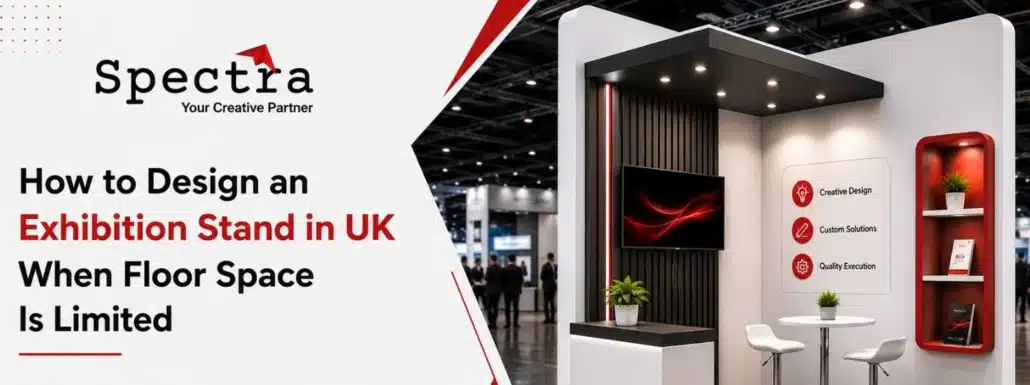
How to Design an Exhibition Stand in UK When Floor Space Is Limited
In this case, better if you plan vertically, not horizontally. Most exhibitors default to spreading things out, and that’s what makes a small stand feel smaller. A tight footprint forces better decisions, fewer props, one message, cleaner sightlines, so the fundamentals of exhibition stand design UK teams rely on matter more here than on a huge stand where mistakes get hidden by sheer size.
At Spectra Creatives, we’ve seen plenty of stands where the space itself seems to be working against the design – odd corners, L-shaped layouts and walkways that leave barely enough room to squeeze through. Yet those limitations don’t always hurt a stand’s appeal. Quite often, a well-planned smaller booth gets more attention than a much larger one sitting right beside it.
What’s the Smartest Way to Plan a Small Exhibition Stand?
Think about foot traffic before you think about furniture. People avoid stands that feel closed in, so the entry point needs room to breathe even if that means sacrificing a display panel somewhere else.
- Build up rather than out. Tension fabric walls and raised graphics do a lot of the visual work without eating floor space
- Stick to one message. A stand trying to say five things at once usually communicates none of them well
- Keep the entrance open. A funnel-shaped approach makes people hesitate before walking in
- Choose furniture that pulls double duty, like a counter with storage underneath, instead of adding separate pieces
Which Stand Styles Actually Hold Up in a Tight Footprint?
A lot of exhibitors just shrink a big-stand idea to fit a small space. That doesn’t really work. Open layouts without a back wall tend to do better than closed-in ones, and an angled entrance draws in more people than a flat, straight-on one. Fabric graphics show up a lot in good exhibition booth designs for small spaces, mainly because they fold up small and go up fast. If you’re doing three or four shows a season, that speed matters more than it sounds like it should.
Does Lighting Actually Change How Big a Stand Feels?
It does, more than most people expect. Uplighting along a back wall pushes the eye outward and makes the space read as deeper than it is. Pale colours help too, since they bounce light rather than swallowing it. A mirrored panel adds visual depth without taking up real room. And oddly enough, leaving some space genuinely empty tends to read as more premium than filling every gap with signage.
Local Contractor or National Team, Which Makes More Sense?
If you’re exhibiting somewhere like the NEC, geography starts to matter in ways people don’t always plan for. Working with an exhibition stand contractor Birmingham based teams can reach without a long drive tends to mean quicker fixes on-site and less lag between a problem showing up and someone solving it.
- Site visits happen faster when the team isn’t three hours away
- Local knowledge of loading bays and venue rules saves time nobody has on build day
- Transport costs stay lower for a smaller stand, which adds up over multiple shows
- Dismantling and storage tend to go more smoothly with a nearby crew
Is a Bespoke Stand Worth It When Space Is This Limited?
Off-the-shelf modular pieces waste space you don’t have to spare. That’s where custom design earns its keep. The bespoke exhibition stands London exhibitors commission are usually built to the exact millimetre, nothing hanging over, nothing left short. At Spectra Creatives, that’s the starting point for any compact brief: measure the space first, design around what it actually allows, then work out materials and finish once the layout is locked.
So How Do You Pick the Right Design Partner?
Ask whoever you’re considering what questions they lead with. If it’s budget before objectives, that’s telling. The better work in exhibition stand design UK comes out of partners who get pulled in at the concept stage rather than handed a brief to execute. The same goes for exhibition booth designs worth remembering. They rarely come from whoever spent the most, they come from whoever understood what to leave out.
A Few Quick Questions
What’s the minimum space needed for an exhibition stand in the UK?
Shell scheme stands typically start around 9 square metres, though a well-planned layout can still land well below that.
How early should planning start for a small stand?
Roughly 8 to 10 weeks out, which leaves room for fabrication and any changes that come up along the way.
Can a small stand actually compete with the bigger ones on the floor?
Often, yes. A clear message and decent lighting will outdo a large, cluttered stand more often than people assume.
Ready to Make a Small Space Work Harder?
A tight footprint isn’t a limitation so much as a filter, it forces the good ideas to the front. Get in touch with Spectra Creatives and we’ll build something that earns its space.





 Germany:
