
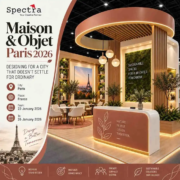
Maison & Objet Paris 2026: Designing for a City That Doesn’t Settle for Ordinary
Walk into most trade shows, and you’ll see the same thing everywhere, from pop-up banners to generic counters to maybe a TV screen looping a product video nobody’s watching. This approach may be applicable to industrial exhibitions, but it completely fails at Maison & Objet Paris. The 2026 edition of the exhibition aims to redefine contemporary interior design under two concepts — “Past Reveals Future,” which is organized in January, and “Pulse in Motion,” which is scheduled for September. The exhibition signifies a global shift from the sterile, mass-produced minimalism to spaces full of character and emotions, so the stalls must tell a visual story, not only showcase a product.
Designing for the Critical Eye
The audience walking these halls has seen it all, from Milan to London. They’re not impressed by size or by how many products get crammed onto a shelf. What actually stops them is restraint done well: a lighting choice that feels intentional, a material that invites touch, and a layout that breathes instead of overwhelms. A brand showing up at Maison & Objet Paris with the standard stall is not going to help. It should feel like a small, curated extension of the brand itself and do justice to the products being presented.
The Art of Spatial Curation in Paris
Quality design at this stage is all about influencing movement. Rather than putting one product after the other, it is better to organize zones. For example, you can create a serene reception zone for calm conversations with designers, several unique displays that tell different parts of the brand’s narrative, and a couple of eye-catching spots that quietly attract attention. Some important ideas to take into account while designing such a layout:
- Ambient lighting that shifts mood by zone, rather than one flat wash of light across the whole exhibition stand
- Material choices, such as matte over gloss and natural wood grain over polished plastic. A careful material choice signals craftsmanship rather than mass production
- Sustainable and circular materials that hold a premium look without leaning on excess
- Subtle tech, like hidden projection mapping, instead of loud screens competing for attention
A genuinely bespoke exhibition stand design earns its name here, and not by being expensive, but by being specific to the brand it represents.
Navigating Parisian Execution
None of this works without execution that matches the ambition. Paris Nord Villepinte runs on strict venue regulations, tight build windows, and finish standards that don’t leave room for shortcuts. This is precisely why working with experienced stand builders in France makes such a difference. Local teams understand the compliance side of things as well as the craftsmanship side, and at a show like this, both matter equally. A stand that looks stunning on paper but stumbles on installation day defeats the entire purpose of showing up.
A Different Philosophy
At Spectra Creatives, we never lose sight of the fact that any interior design exhibition needs an architectural approach instead of a building one. Each material, each sightline, and each quiet hospitality corner is treated as a component of our project rather than an additional detail attached to a booth. At the same time, the brands that everybody remembers at any exhibition are not always the loud ones. Instead, it is the brands that seem to fit almost perfectly into the exhibition space that people remember.

 Germany: