
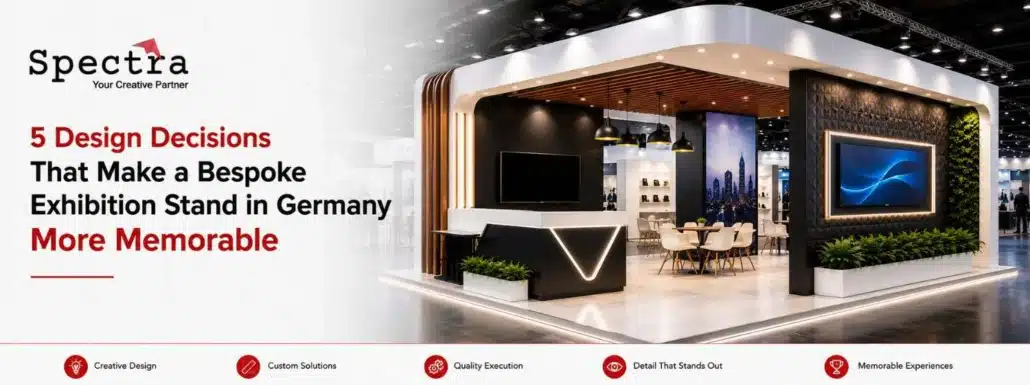
5 Design Decisions That Make a Bespoke Exhibition Stand in Germany More Memorable
We get asked a lot what actually makes an exhibition stand in Germany stick with people. Usually it’s not one big thing. It’s the layout working properly, decent materials, good lighting, a story worth remembering, and a build that doesn’t waste half of itself after one show. Get most of that right and people bring your brand up weeks later, long after Hannover Messe or IFA Berlin has ended. At Spectra Creatives, we’ve seen one bad decision quietly ruin months of good planning.
1-Layout Flow That Keeps Visitors Walking In
A lot of exhibitors pour the budget into graphics and treat the floor plan as an afterthought. A narrow entrance, or a reception desk tucked behind a wall of banners, kills footfall before anyone’s said hello. What works better is simpler than people expect: open sightlines, a welcome area that reads clearly from a distance, and one spot to sit for longer conversations. Hannover Messe pulls in visitors from more than 60 countries most years, so a floor plan that makes sense at a glance counts for something. It’s a fast way to make an exhibition stand in Germany feel considered rather than thrown together.
2-Material Choices That Change How a Stand Feels
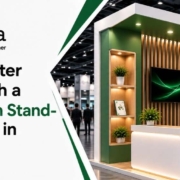
Timber, brushed metal, fabric panels, backlit acrylic, each sends a different message before a rep opens their mouth. A few patterns we’ve noticed:
- Warm woods and soft textiles tend to suit lifestyle or wellness brands
- Matte metal and glass lean precise, which works well for tech and engineering companies
- Fabric structures pack down light, handy if you’re doing several cities in a row
- Reusable modular panels save money over repeat bookings, and cut down on waste too
This is really the heart of bespoke exhibition stand design. Materials get chosen because they fit the brand standing inside them, not because they were sitting on a shelf.
3-Lighting Design That Shapes First Impressions
Lighting rarely gets the budget it deserves. Flat overhead lighting flattens whatever’s underneath it, and a well-built stand can end up looking like a warehouse aisle under the wrong fixtures. Layering helps: accent spots on hero products, something warmer near the seating, a bit brighter at the entrance. Small change, but it shifts how premium a space feels within seconds.
4-A Story Strong Enough to Influence Buying Decisions
More than most exhibitors give it credit for. Walk Frankfurt’s Messe complex for an afternoon and dozens of booths blur together. The ones people remember have one clear thread: what the product solves, who it’s for, why that matters now. What tends to hold that thread together:
- One message you can read from ten metres away, not five competing ones
- A single product people can actually touch, not just a spec sheet
- Staff who can pitch it in two sentences, not a memorised script
An exhibition stand in Germany without a story usually ends up as “the one near the coffee stand,” not because it looked bad, just because nobody left with a reason to remember it.
5- Sustainable Building as a Genuine Selling Point
Germany hosts roughly two-thirds of the world’s leading international trade fairs, and organisers have spent the last few years pushing exhibitors toward reusable, lower-waste builds. Modular frames that get reconfigured for the next show, FSC-certified timber, water-based inks, none of it’s a box to tick anymore. German visitors, especially in industrial circles, actually ask about it. Skip that conversation on an exhibition stand in Germany and it starts looking dated fast.
Why Do These Five Decisions Work Best Together?
None of this works well in isolation, and that’s easy to miss. A beautifully lit stand with no story falls flat. A great story on cheap materials feels unconvincing before anyone reads a word of it. That’s the whole case for bespoke exhibition stand design: every piece supports the same idea, instead of getting cobbled together from a rental warehouse. It’s also why brands comparing stand builders Germany wide keep circling back to the same small group of studios, ones that treat design and fabrication as one job, not two separate hand-offs.
Spectra Creatives has built across enough German cities by now, Cologne, Munich, Frankfurt, to know which of these five decisions tends to slip when deadlines get tight, and which ones quietly decide whether a stand gets remembered past opening day.
Frequently Asked Questions
How far in advance should a bespoke stand be planned?
Most major fairs need somewhere around 8 to 12 weeks for a fully custom build. Larger footprints usually need more.
Do modular stands cost less than fully custom builds?
Often, at least upfront. Though a well-designed modular system can get reused across several shows, which changes the maths over time.
Is Frankfurt the best city for exhibition builds in Germany?
It’s certainly one of the busiest, given how many major fairs pass through it, which is part of why demand for exhibition stand builders Frankfurt stays steady year-round. Cologne, Munich, and Düsseldorf all see plenty of activity too, though.
Ready to Build Something Memorable?
If your next trade fair deserves more than a rented shell, Spectra Creatives can help you shape a stand that actually holds a room. Get in touch and let’s talk through what you’re building next.

 Germany:
